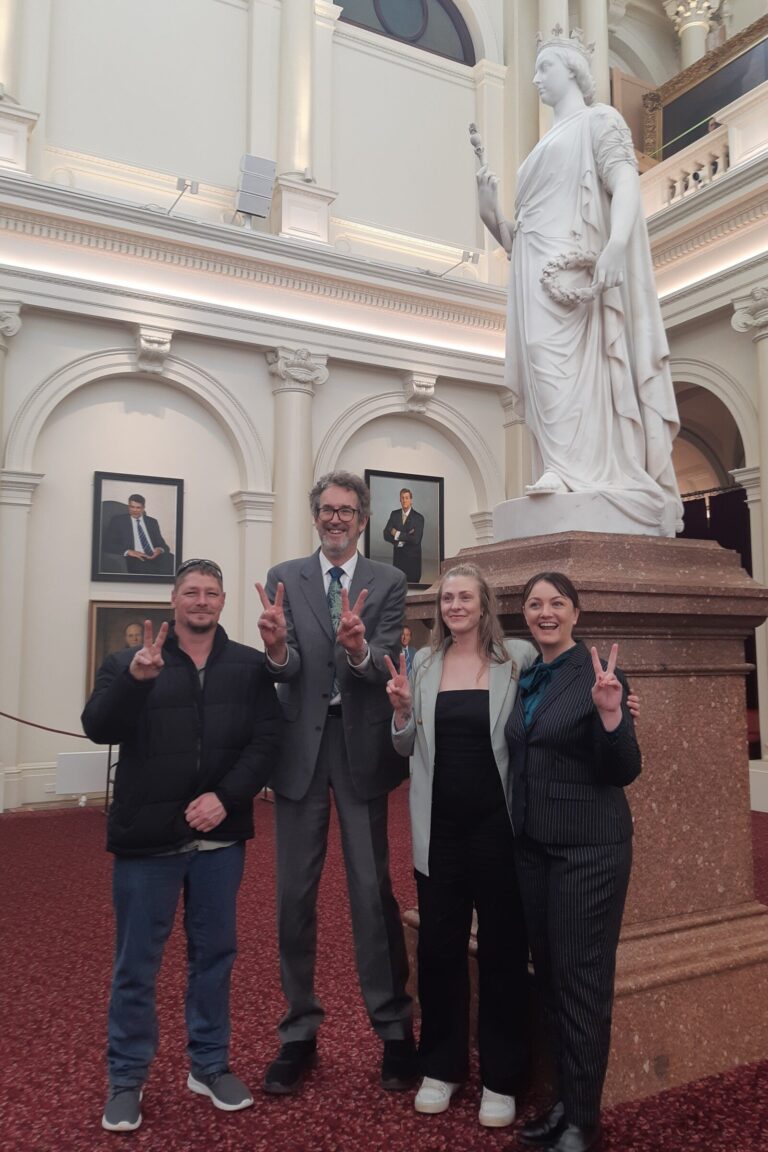

Rachel made a contribution to the Crimes Amendment (Retail, Fast Food, Hospitality and Transport Worker Harm) Bill 2025. She noted that a rise in retail theft is largely driven by cost-of-living increases. She asserted that while worker safety is essential, new laws must be fair and effective and not exacerbate inequality. As such, a two-year statutory review is essential to determine effectiveness and address any unintended consequences.
Tuesday the 2nd of December, 2025
Victorian Legislative Council
Rachel Payne (South-Eastern Metropolitan):
I rise to speak on the Crimes Amendment (Retail, Fast Food, Hospitality and Transport Worker Harm) Bill 2025 on behalf of Legalise Cannabis Victoria. This bill amends the Crimes Act 1958 and the Summary Offences Act 1966 to protect workers in customer-facing retail, fast-food, hospitality and passenger transport industries from harm. As my colleague David Ettershank has previously raised in this place, the Allan Labor government has failed to adequately respond to a surge in crime in retail settings in Victoria. According to data from the Crime Statistics Agency, there were over 41,000 incidents of theft from retail stores in the 2024–25 period, an increase of 27.6 per cent in the past year alone. Food theft has risen by over 80 per cent, and cigarette and alcohol theft by 58.6 per cent.
While these statistics are gobsmacking, increased rates of shoplifting are symptomatic of a cost-of-living crisis in this state. It is concerning that this rise in abuse and violence towards retail staff is what we are seeing. According to the Victorian Shop, Distributive & Allied Employees’ Association, or SDA, state secretary Michael Donovan, workers are being screamed at, spat on, shoved, dragged across counters, slashed and stabbed. That is just appalling. Data from the Australian Retailers Association shows that 51 per cent of workers experience physical abuse monthly or more often and 87 per cent of retail workers experience verbal abuse.
Young women workers in the retail firing line
In my former professional life, before becoming a member of Parliament, I actually represented retail industry workers. I represented adult industry workers. I always like to reflect on my time there, because, interestingly, those businesses were more often than not self-regulating in this space around safety. Things like duress alarms, security cameras, internal training mechanisms and safety precautions were all part of the business model that the adult industry reflected upon, because everyone deserves to feel safe at work, no matter what they are selling or what kind of work they are offering. But increasingly, retail workers are confronted with violent harassment and abuse. It is not an easy job, but for many, it is often their first job. More than a third of the workforce is made up of young women between the ages of 15 and 24. We are deeply concerned that it is only a matter of time before a fatality occurs, particularly as we head towards the Christmas season, when demand on retail workers is at an all-time high.
Turning now to the details of this bill, it will introduce three new offences. This includes a new indictable offence for assaulting or threatening to assault an applicable worker in connection with the performance of the worker’s duties. The maximum penalty for this offence will be five years imprisonment. This is modelled on an existing offence, but it will be easier to prove as it does not require an accused to have an intent to commit an indictable offence. Secondly, this bill will introduce a new summary offence for lower-level assaults for applicable customer-facing workers in connection with the performance of their duties. The maximum penalty for this offence will be 60 penalty units or six months imprisonment. This is intended to be used in place of the existing common assault offence that it is modelled on, allowing for a doubling of the penalty.
Offensive language summary offence
Thirdly, this bill will introduce a new summary offence of without lawful excuse using language that is profane, indecent, obscene, threatening, abusive or insulting or otherwise engaging in conduct that is threatening, indecent, offensive or insulting towards a protected worker in connection with the performance of the worker’s duties. The maximum penalty for this offence will be 25 penalty units or six months imprisonment. This offence also builds on an existing offence but will not require the conduct to have occurred in a public place and will triple the existing maximum penalty of two months’ imprisonment.
Another notable element of this bill is that it will provide that the offence of aggravated burglary will apply when a person commits a burglary and uses a vehicle to cause damage to the building for the purpose of gaining entry to that building. This will ensure that ram raids are taken seriously when it comes to sentencing, recognising that a car is effectively being used as a weapon.
Two-year statutory review will examine efficacy
The final notable component of this bill is the requirement that it be subject to a statutory review within two years of commencement. It is particularly important to us that this legislation be reviewed, as it is nowhere near perfect. We have heard from legal stakeholders that a lot of what is in this bill seeks to merely duplicate offences and adds further unnecessary complexity. Statutory review will be essential to understanding whether these new offences end up being used at all and if there are any unintended consequences. We also want to make sure that the offence in this bill for language that is profane, indecent, obscene, threatening, abusive or insulting does not end up capturing people who are frustrated and may have dropped a swearword or two. We will raise this and other issues during the committee stage of this bill.
Potential for unintended consequences
We are also deeply concerned that the impacts of this bill will not be felt equally. Data from the Racial Profiling Data Monitoring Project has again showed that Aboriginal people are overpoliced. Aboriginal people are 15 times more likely to be searched by Victoria Police officers than non-Aboriginal people and are 10 times more likely to have force used against them. This is despite Victoria Police claiming they banned racial profiling in 2015. We expect that if a statutory review shows that these new offences are not keeping workers safe and are instead targeting marginalised communities, these laws will be repealed.
I reiterate: every person has the right to feel safe at work; no-one should be intimidated or threatened or harassed or harmed when they are in their workplace. But amid an epidemic of retail crime across this state, often young, inexperienced people are the ones who are put on the front lines, and they deserve better.