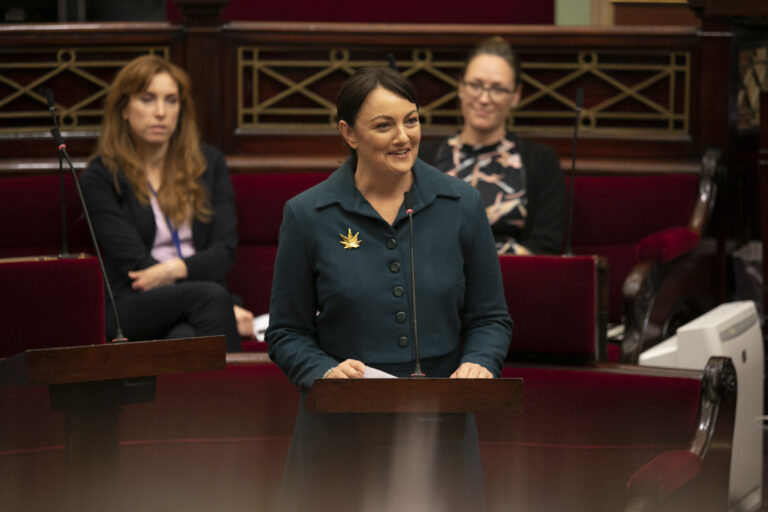

Rachel has previously voiced concerns in the chamber around the dissolution of the Victorian Assisted Reproductive Treatment Authority (VARTA), which was responsible for the regulation of Assisted Reproductive Treatment, and education programs.
With informal ‘rogue’ sperm donors exploiting women and putting families at risk, Rachel asked what the government is doing to regulate informal sperm donation and educate the public on its potential harms.
Tuesday the 16th of June 2026,
Victorian Legislative Council
Rachel Payne (South-Eastern Metropolitan):
My question is for the Minister for Health, Minister Shing. While there have been recent improvements around Victoria’s formal fertility clinics, media and stakeholders are reporting concerning information about informal clinics. The current conditions are a perfect storm for exploitation: there is a chronic sperm shortage through clinics, IVF is very expensive and we have the internet – there are unregulated groups operating via Facebook and Instagram and on websites. One such group has 16,000 members, with reports of women being offered sperm but only if they are willing to conceive naturally.
Experts are unanimous that informal sperm donations put recipients, donors and children at risk: proper records are not kept, health checks are not mandated, Victoria’s 10-family limit is not enforced and there are even reports of sexual assaults.
I ask the minister: what is the government doing about regulating informal sperm donors who are operating in the open and seemingly with impunity?
Harriet Shing (Eastern Victoria – Minister for Ambulance Services, Minister for Health, Minister for Water):
Thank you very much, Ms Payne, for that question and for your interest in and advocacy within this space. We work really hard in Victoria to provide the resources, the supports and the programs for people to realise their dream of becoming a parent and to make sure that IVF is a cost that is able to be managed and accommodated. We do not want to see people choosing between welcoming a longed-for, hoped-for, dreamed-for baby into their families on the one hand and costs that are prohibitive around other areas of life on the other. The matters that you have referred to are nothing short of vile. No-one should be exposed to a level of vulnerability in seeking to access sperm for the purpose of conception. I just want to be really clear that that is actually really disgusting behaviour. Not only does it erode the pathways for consent, but it also seeks to commodify and to exploit people in a time of extreme vulnerability.
As endorsed at the health ministers meeting last September, there was a review of donor matters to the Australian Law Reform Commission. We have got long-established regulatory safeguards in place to protect the safety and wellbeing of everyone involved in egg or sperm donation. We have Australia’s first public egg and sperm donor service, and in this year’s budget we have continued to support public IVF, which we introduced with $43 million. There are 350 little ones who have been welcomed as a result of public IVF services here in Victoria. Anyone looking to donate or to use donated sperm should ensure that they are really aware of the legislated safeguards, but also under the Human Tissue Act any advertising in relation to donations has to be approved by the health minister.
Failing to obtain this approval is actually an offence; it can be punishable by imprisonment – and for good reason.
I want to be very clear that we will continue to support public fertility care. We will continue to identify and to address those barriers that we know are all too common for people who may find themselves in these groups online, looking for the opportunity to have a child, only to be met with some sort of biological blackmail. It is absolutely disgraceful, and we do want to make sure we are addressing those costs and barriers so that more people can have a baby in a safe and regulated way.
Rachel Payne:
I thank the minister for her very thoughtful response. By way of supplementary, I have spoken several times in this chamber about the closure of the Victorian Assisted Reproductive Treatment Authority, or VARTA. This world-leading service was responsible for regulating fertility clinics and protecting the best interests of people receiving treatment and donor-conceived children.
It also performed the vital function of community education, and we know community education in this space is essential. It is often our most vulnerable women who are targeted by rogue operators. These are women who are single, from the LGBTIQ community and on lower incomes. It is essential that they are fully aware of the dangers of informal sperm donation.
Now that VARTA has been absorbed into the Department of Health, I ask the minister: what education programs are the department running, for both recipients and donors, about the dangers of informal sperm donations?
Harriet Shing:
Thank you very much for that, Ms Payne. We do want to make sure that we are continuing to provide people with access to accurate information but also the sorts of supports that are available for people to find services that will meet their needs and to make complaints if they either see or are party to any transactions or advertising around the sorts of practices that you have talked to.
Anybody who does have a complaint or any information about the practices that you have referred to should report it to the health regulator, or if there is a criminal complaint – as I have just indicated, this is punishable by imprisonment – report it to police.
I want to touch very quickly on VARTA and the work that you have done, but before I do that, the health regulator is aware of the issue that you have spoken to and is investigating it. Again, we want to make sure that we continue to regulate ART providers. There is not enough time to go into it but let us keep talking about it.
Related:
- Families left behind after VARTA dissolution – Rachel Payne
- Assisted reproductive treatment regulation – Rachel Payne
- Health Legislation Amendment (Legislative Reform) Bill 2024 – Rachel Payne